Tekin Analysis | The Collapse of Serverless Edge Isolation
An exhaustive technical autopsy of the remote Spectre side-channel attack on Cloudflare Workers that leaked JWT authentication tokens at 12 bits per second.
- 🎮12 bps Leakage Rate at >99% Accuracy- A 360-fold acceleration in cross-tenant microarchitectural data exfiltration over previous 2021 demonstrations.
- 🎧Remote-Timer-as-a-Service (RTaaS)- Circumventing the total absence of local high-resolution timers using WebSocket network packet round-trips.
- 🚀Triple-Tier Hardware Defense- Mitigation deployed across global edge clusters combining Dynamic Process Isolation (DyPrIs), V8 Sandbox, and Intel MPK.
For the past decade, multi-tenant serverless edge computing has been heralded as the pinnacle of internet infrastructure efficiency. Platforms such as Cloudflare Workers revolutionized global application delivery by abandoning heavyweight virtualization containers in favor of lightweight Google V8 engine isolates, co-locating thousands of mutually untrusted customer scripts inside a shared operating system address space with sub-millisecond cold starts.
However, a landmark research collaboration between Cloudflare's internal security engineering division and academic researchers at the University of Edinburgh has uncovered a profound structural vulnerability in this model. The research demonstrates that speculative execution side-channels (Spectre) can be weaponized remotely across co-located V8 isolates, extracting private JSON Web Tokens (JWTs), sensitive cryptographic secrets, and raw memory contents with alarming precision.

The Fragility of Shared Memory: Why V8 Isolates Face Microarchitectural Peril
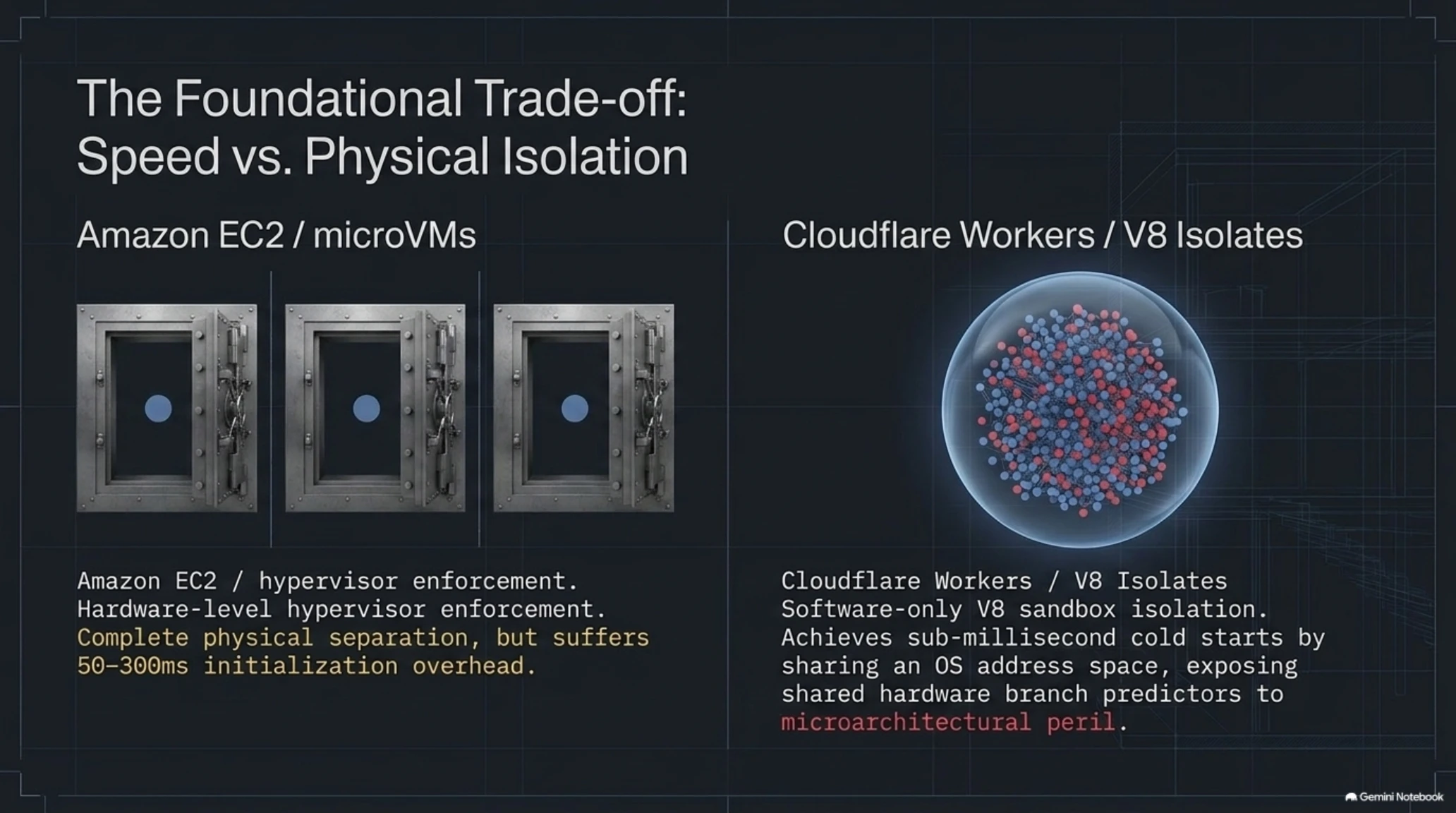
To grasp the profound implications of this breakthrough, infrastructure engineers must examine the foundational trade-offs governing modern cloud runtimes. In traditional public cloud architectures—such as Amazon EC2 or AWS Lambda running on Firecracker microVMs—isolation boundaries are enforced directly at the hypervisor and hardware virtualization layer (VT-x / AMD-V), dedicating distinct page tables and virtualized registers to each tenant.
While microVMs guarantee robust physical separation, their initialization overhead (typically 50 to 300 milliseconds) proved intolerable for low-latency edge routing. Cloudflare Workers solved this by hosting multiple customer tenants within a single monolithic Linux process, relying entirely on the V8 JavaScript runtime's software sandbox to prevent cross-boundary memory indexing. The newly disclosed remote Spectre exploit proves that when shared hardware branch predictors are involved, software-only isolation guarantees collapse under microarchitectural scrutiny.
Executive Summary | Critical Findings of the Cloudflare Workers Spectre Breach
- Successful demonstration of cross-isolate speculative execution memory reads between distinct tenants co-located in the same operating system process.
- Attainment of an unprecedented 12 bits per second data transmission rate with an empirical accuracy rate exceeding 99.2%.
- Engineering of Remote-Timer-as-a-Service (RTaaS) via continuous WebSocket streams, completely bypassing Cloudflare's local high-resolution clock restrictions.
- Immediate global deployment of hardware-level Memory Protection Keys (MPK), V8 Sandbox integration, and Dynamic Process Isolation (DyPrIs).
While Cloudflare has confirmed that no unauthorized customer data was exposed during the controlled academic experiment and zero evidence of in-the-wild weaponization was identified over the preceding three years, the discovery sends shockwaves across the entire edge computing and serverless landscape.

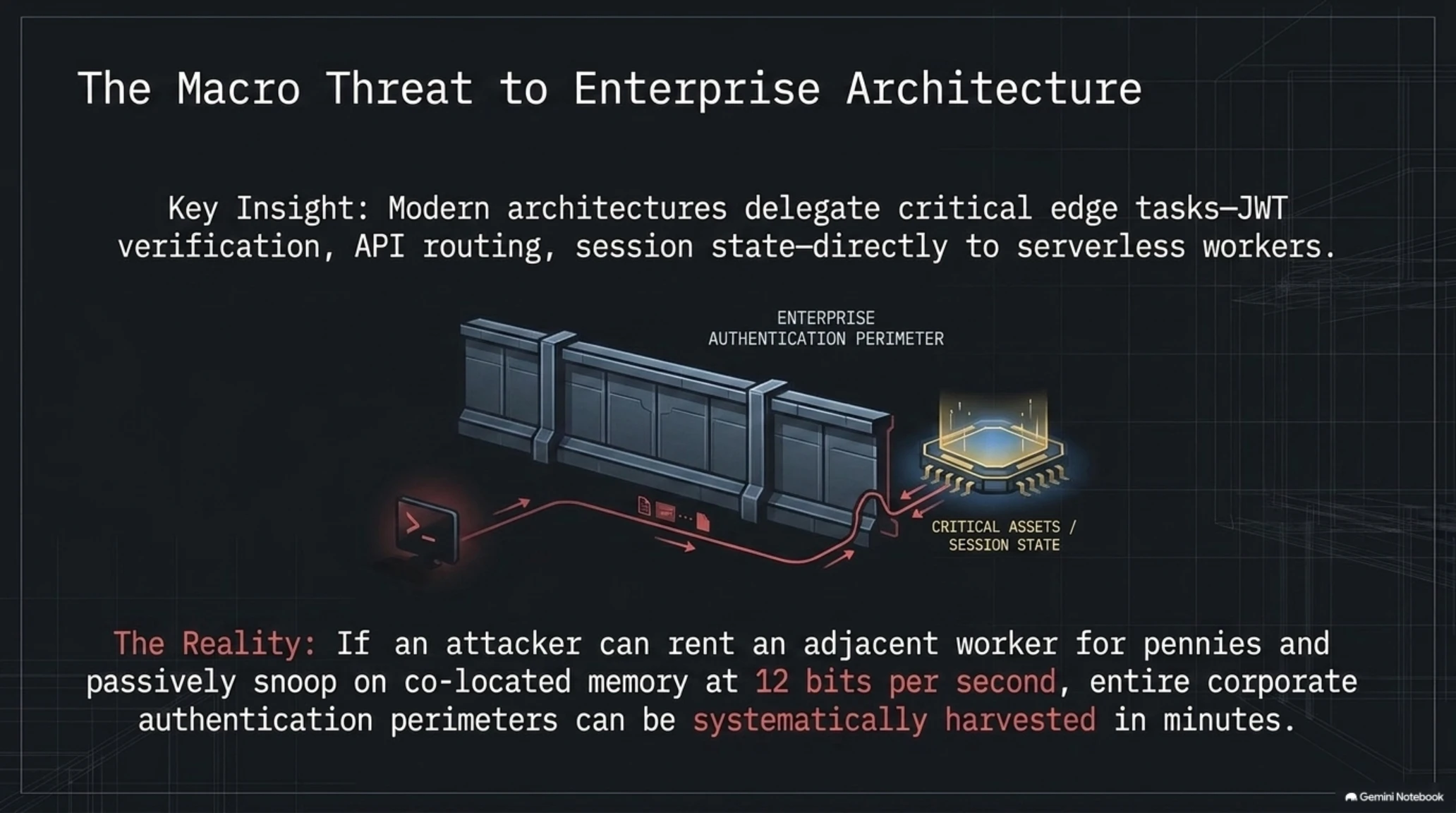
Why It Matters: The Macro Implications for Enterprise Edge Architecture
Foundational Concepts in Speculative Execution and Side-Channel Attacks
A rigorous evaluation of this attack vector requires a precise understanding of the microarchitectural mechanisms that link CPU branch prediction units to remote JavaScript runtimes.
Technical Jargon Buster
V8 Isolate: An isolated execution instance of Google's V8 engine possessing an independent call stack and garbage-collected heap, sharing an OS process with sibling isolates.
Remote Timing Oracle: A distributed timing measurement mechanism capable of discerning sub-microsecond cache access differentials (L1/L2 hits vs. DRAM misses) via network packet arrival intervals.
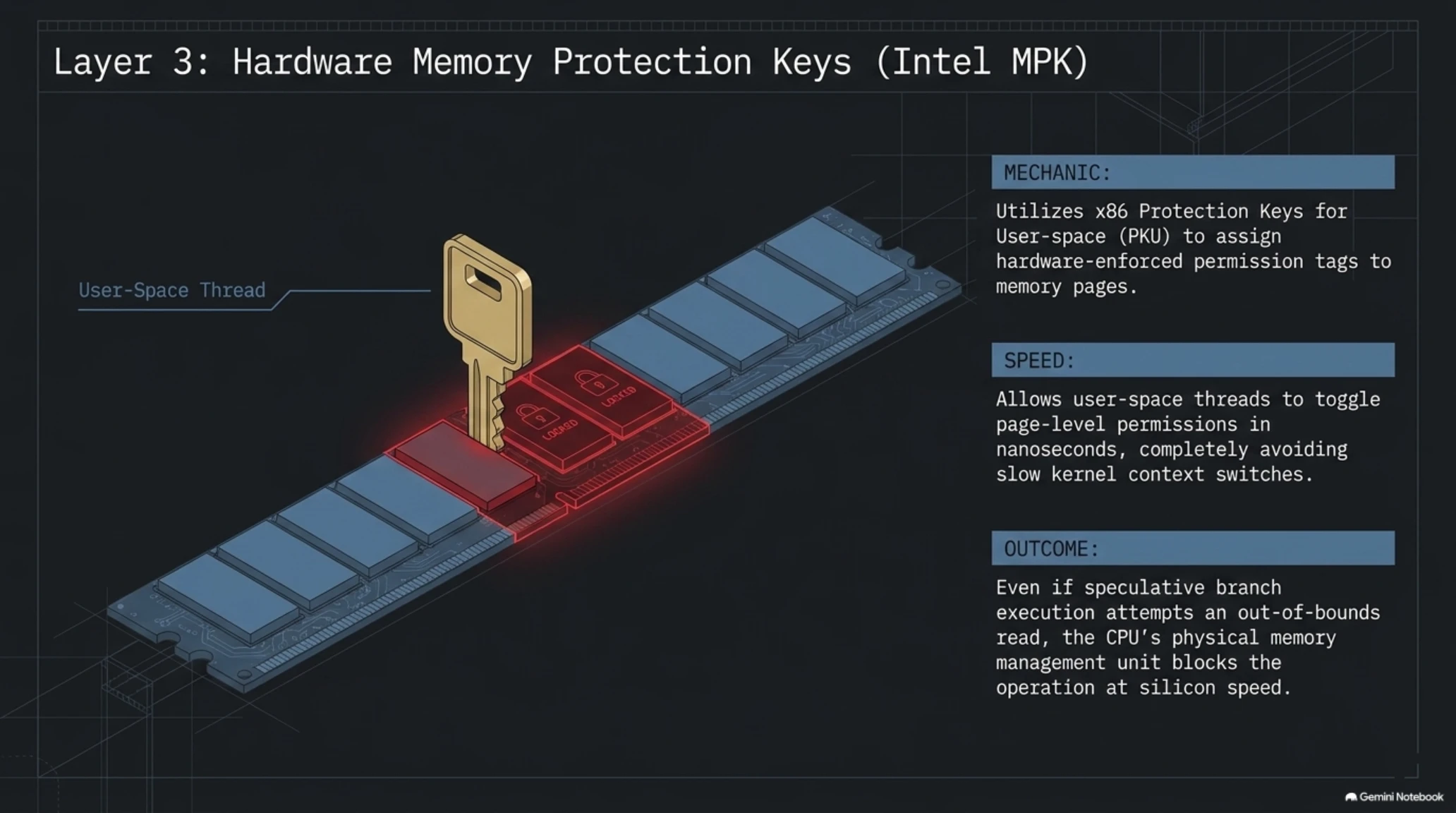
Memory Protection Keys (Intel MPK): An x86 CPU hardware feature (PKU) allowing user-space threads to rapidly toggle page-level read/write permissions within nanoseconds without requiring kernel context switches.
Technical Anatomy of the Attack: How Network WebSockets Replaced Silicon Timers
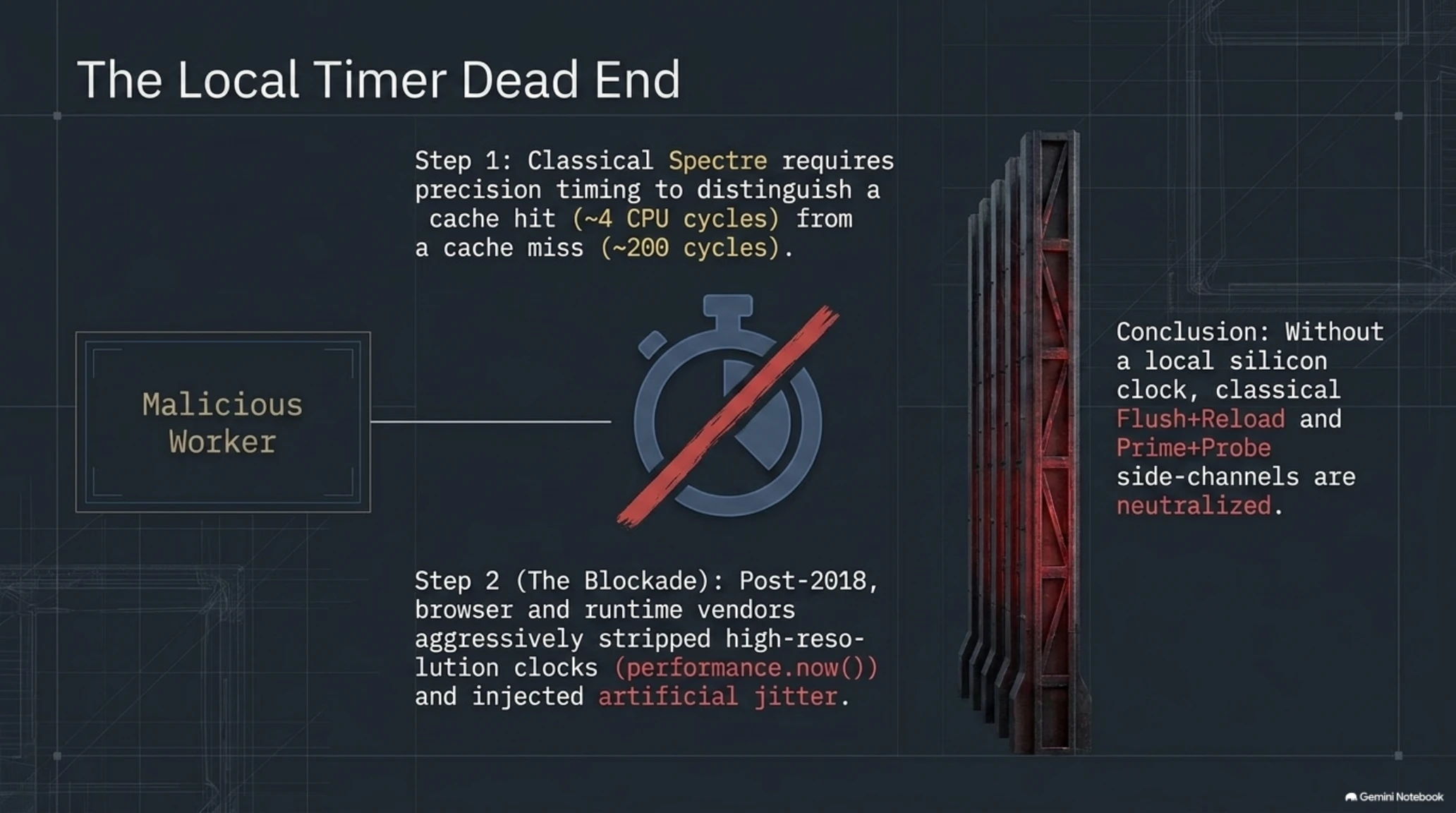
All microarchitectural side-channel attacks rely fundamentally on precision timing measurements to distinguish between a cache hit (data already in CPU cache, resolving in ~4 cycles) and a cache miss (data fetched from main memory, requiring ~200 cycles). Following the initial disclosure of Spectre in 2018, browser and runtime vendors aggressively stripped high-resolution clocks, degrading performance.now() and introducing artificial jitter to blind potential attackers.
Within Cloudflare Workers, local hardware timestamp counters and precise JavaScript timers are strictly suppressed. Without a local clock, an attacker inside a worker isolate cannot natively time memory accesses, rendering classical local Flush+Reload and Prime+Probe techniques ineffective.

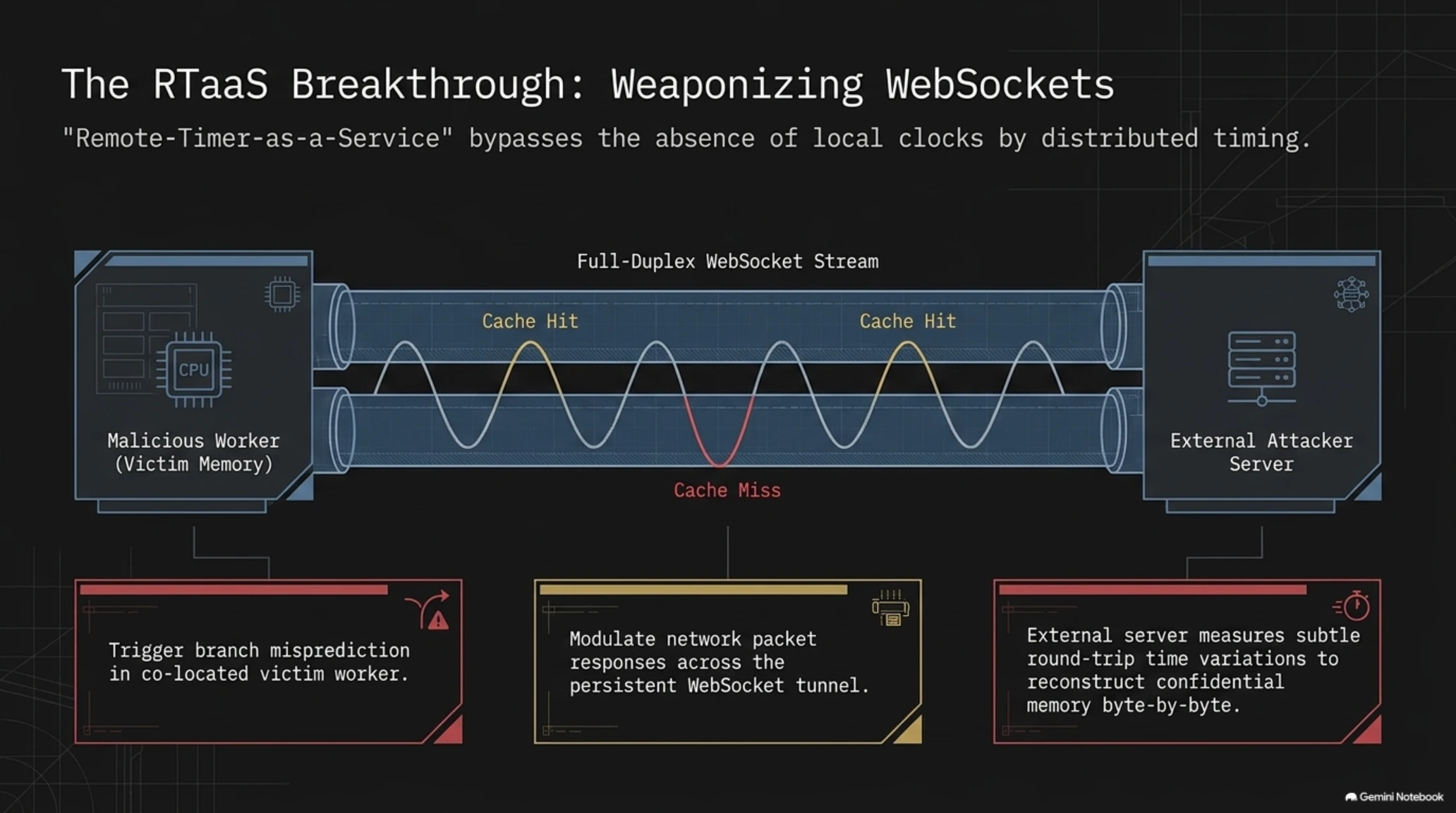
The core breakthrough articulated in the research paper—titled "Remote-Timer-as-a-Service: Efficient Microarchitectural Leakage in the Cloud with Remote Timers"—shattered this defensive paradigm. Instead of relying on local timers, the researchers established a persistent full-duplex WebSocket stream between the malicious worker and an external server under their control, constructing a distributed network timing oracle.
By repeatedly triggering branch mispredictions in the co-located victim worker and modulating network packet responses across the WebSocket tunnel, the external server measured subtle round-trip time variations. This technique enabled the researchers to reconstruct confidential victim memory byte-by-byte at an unprecedented speed of 12 bits per second with greater than 99% accuracy in live production clusters.
Quantitative Attack Metric Analysis: 2021 vs. 2026 Comparison
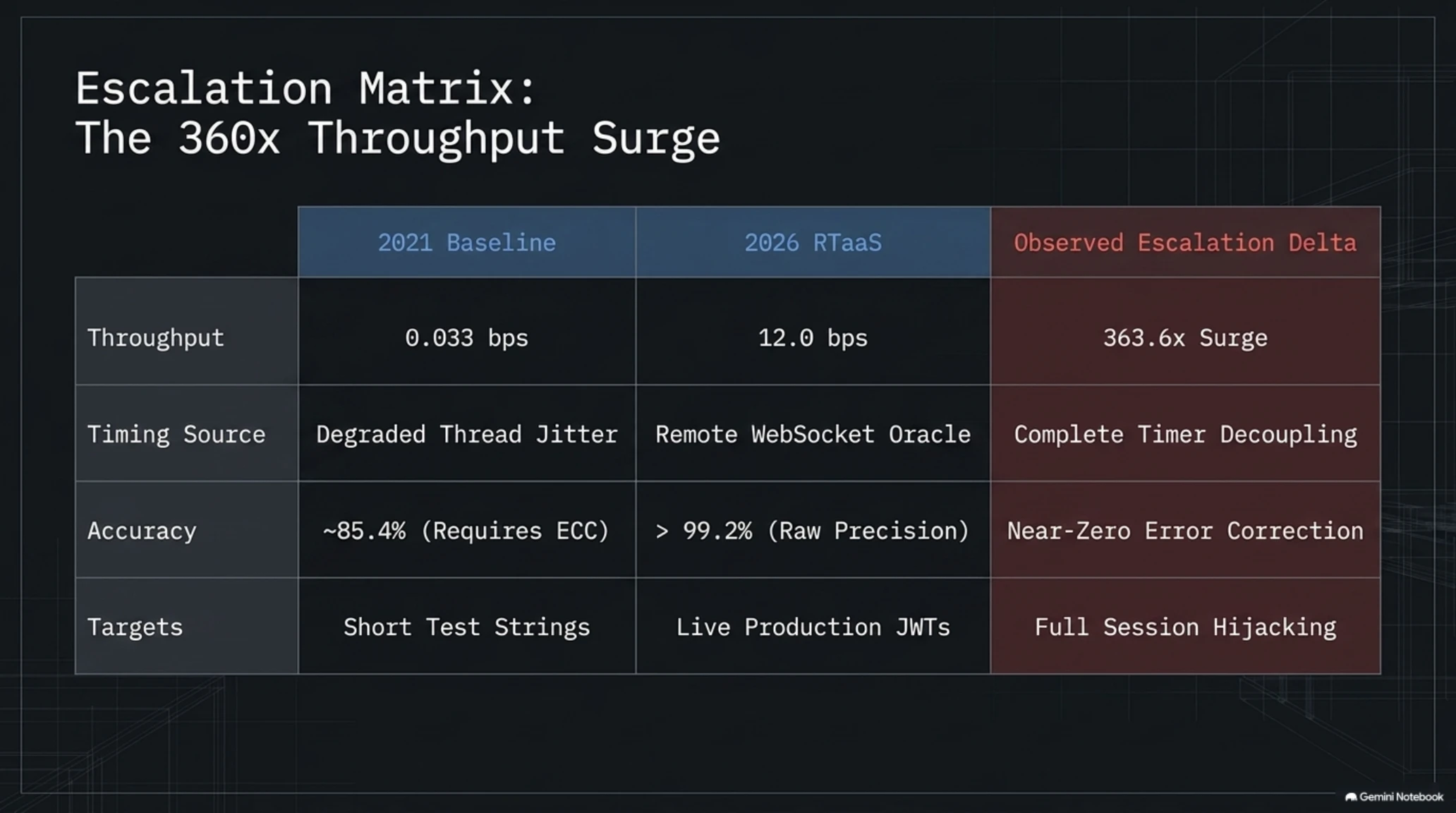
To contextualize the severe escalation represented by this research, the table below contrasts the operational parameters of the 2026 remote WebSocket Spectre attack against earlier edge computing proof-of-concepts.
Evolution of Microarchitectural Leakage Rates in Serverless Environments
| Technical Evaluation Metric | 2021 Baseline Demonstration | 2026 RTaaS WebSocket Attack | Observed Escalation Delta |
|---|---|---|---|
| Exfiltration Throughput | 0.033 bits per second | 12.0 bits per second | 363.6x Throughput Surge |
| Timing Source Mechanism | Degraded Software Thread Jitter | Remote WebSocket Timing Oracle | Complete Timer Decoupling |
| Bit-Reconstruction Accuracy | ~85.4% (Requires ECC) | > 99.2% (Raw Precision) | Near-Zero Error Correction Needed |
| Exfiltrated Production Targets | Short Synthesized Test Strings | Live Production JWT Tokens & Headers | Full Session Hijacking Capability |

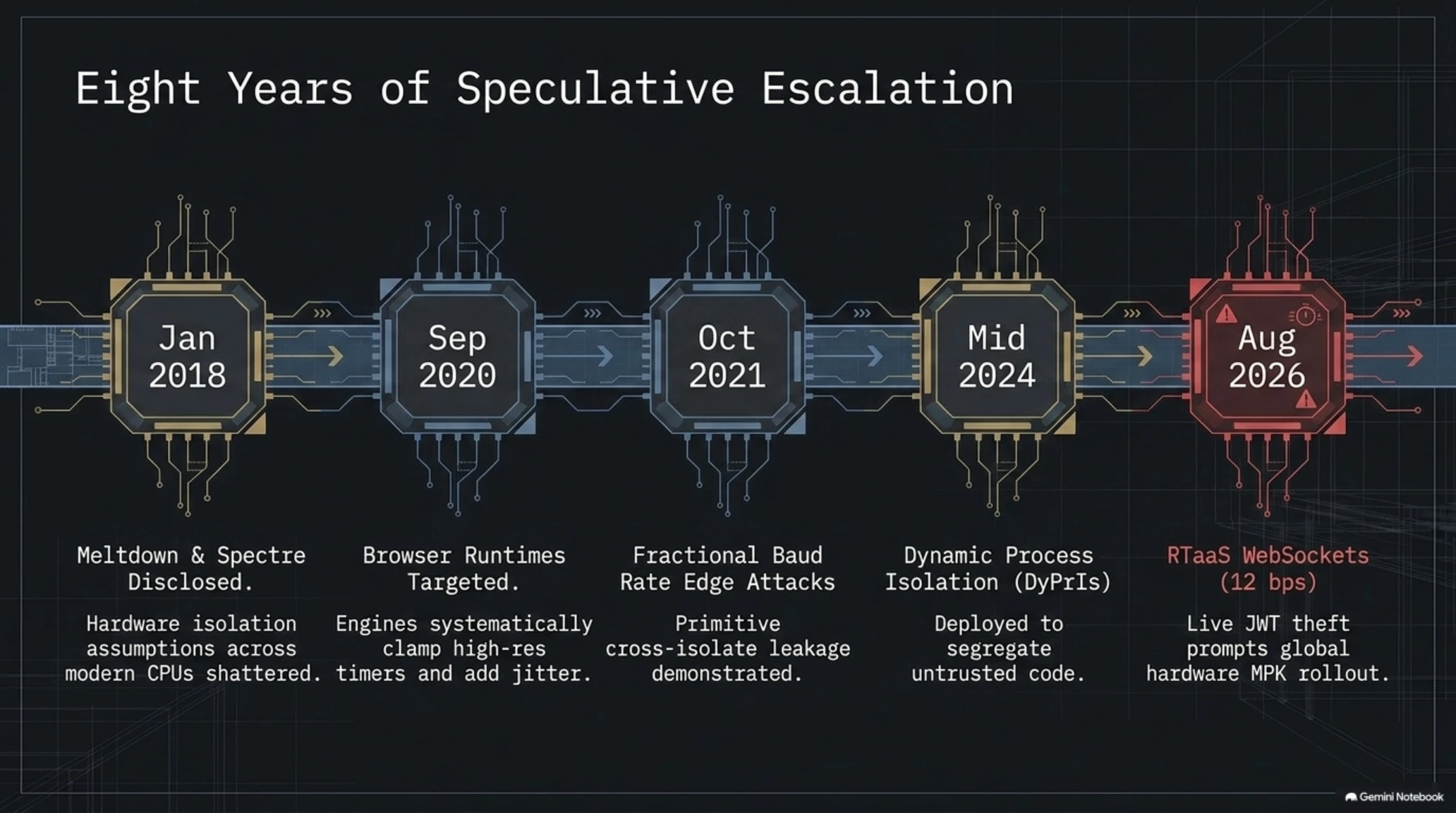
Historical Timeline of Microarchitectural & Edge Computing Breaches (2018–2026)
The progression of speculative execution research highlights how hardware-level vulnerabilities have continually outpaced purely software-driven mitigation strategies over the past eight years.
Timeline of Speculative Execution & Side-Channel Evolution
Cloudflare's Defense-in-Depth: The Triple-Tier Mitigation Architecture
Upon verifying the experimental findings, Cloudflare’s infrastructure engineering teams engineered and rolled out a comprehensive, triple-tier defensive architecture designed to neutralize microarchitectural side-channels without degrading the sub-5ms cold start performance that defines the Workers platform.
This multi-layered approach elevates tenant isolation from an inherently vulnerable software sandbox into a hybrid software-hardware enforcement paradigm.

📚 Classified & Related Dossiers in TekinGame
If you wish to explore beyond this report and delve into cybernetic frontiers and autonomous AI architectures, do not miss these three exclusive deep-dives in the Tekin Garage:
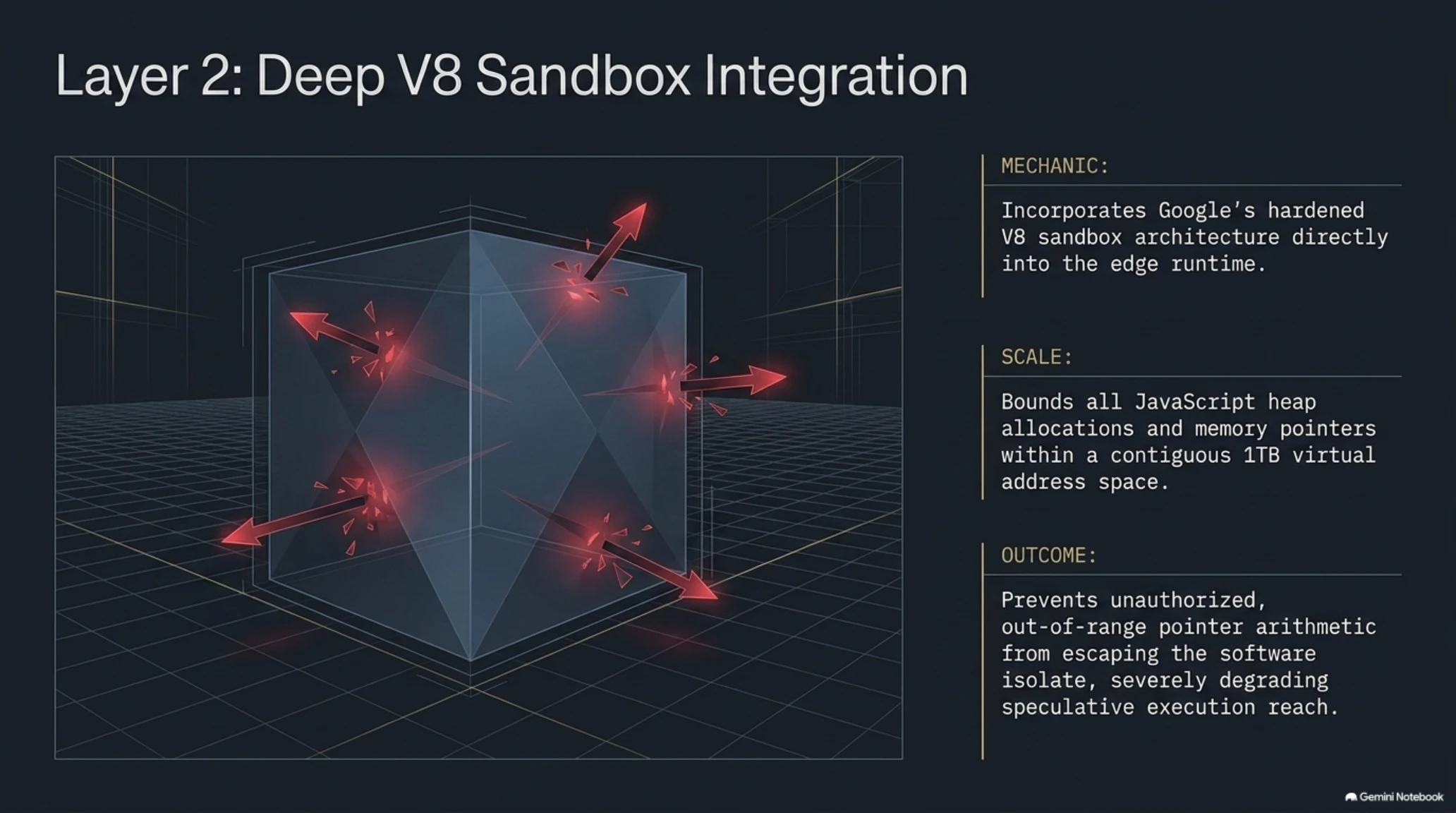
Cloudflare's 3-Layer Serverless Isolation Defense
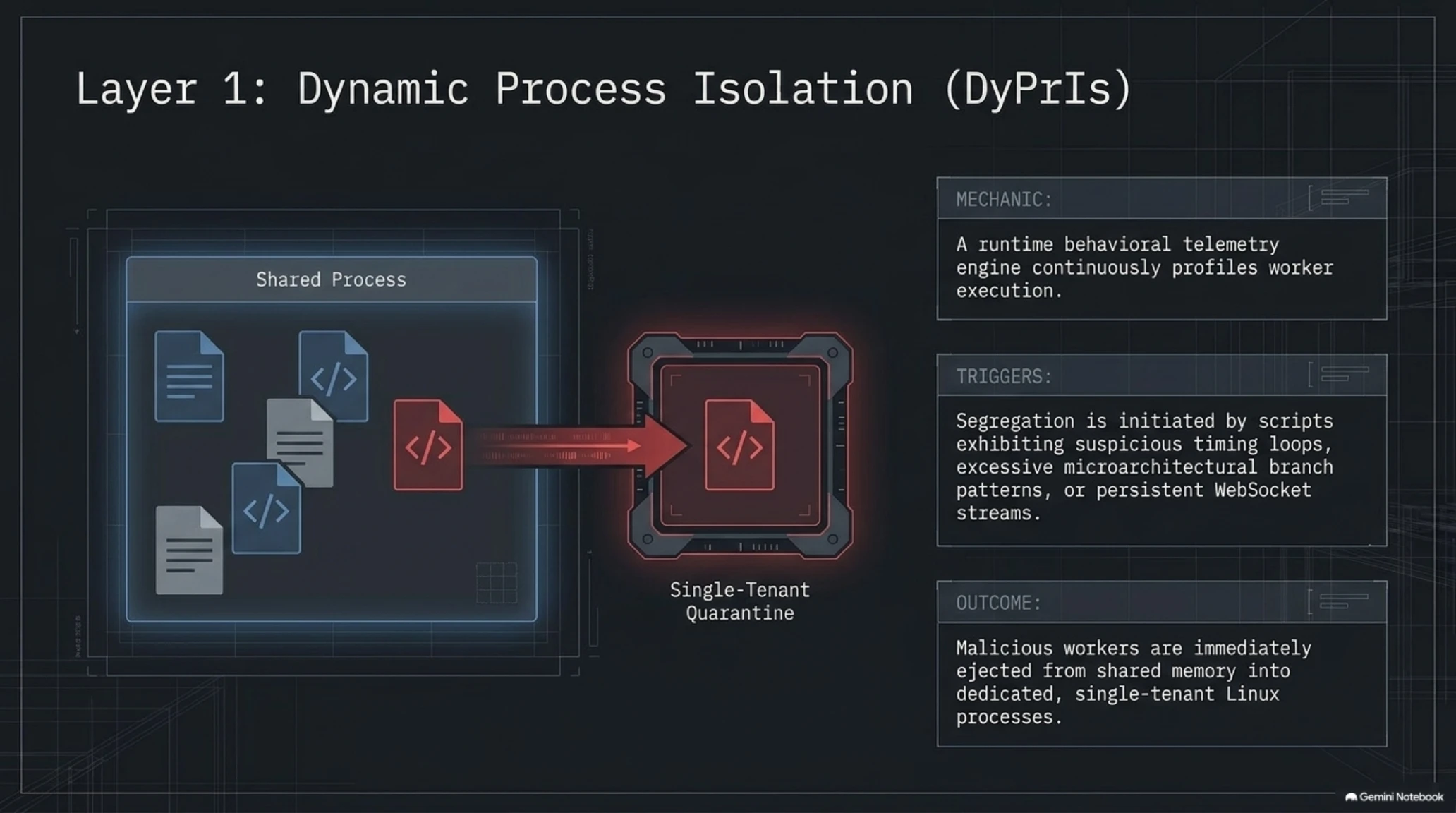
- 1. Dynamic Process Isolation (DyPrIs): A runtime behavioral telemetry engine that continuously profiles worker execution. Scripts exhibiting suspicious timing loops, excessive microarchitectural branch patterns, or persistent WebSocket streams are immediately segregated into dedicated, single-tenant Linux processes.
- 2. Deep V8 Sandbox Integration: Incorporating Google's hardened V8 sandbox architecture, which bounds all JavaScript heap allocations and memory pointers within a contiguous 1TB virtual address space, preventing unauthorized out-of-range pointer arithmetic from escaping the isolate.
- 3. Hardware Memory Protection Keys (Intel MPK): Utilizing x86 Protection Keys for User-space (PKU) to assign hardware-enforced permission tags to memory pages, ensuring that even if speculative branch execution attempts out-of-bounds reads, the CPU's memory management unit blocks the operation at silicon speed.
As documented in our previous technical investigation into stealthy enterprise attack surfaces in the AgentForger Rogue AI & Workspace Security Deep Dive, relying solely on single-layer software controls inevitably exposes enterprise infrastructure to zero-day exploitation.
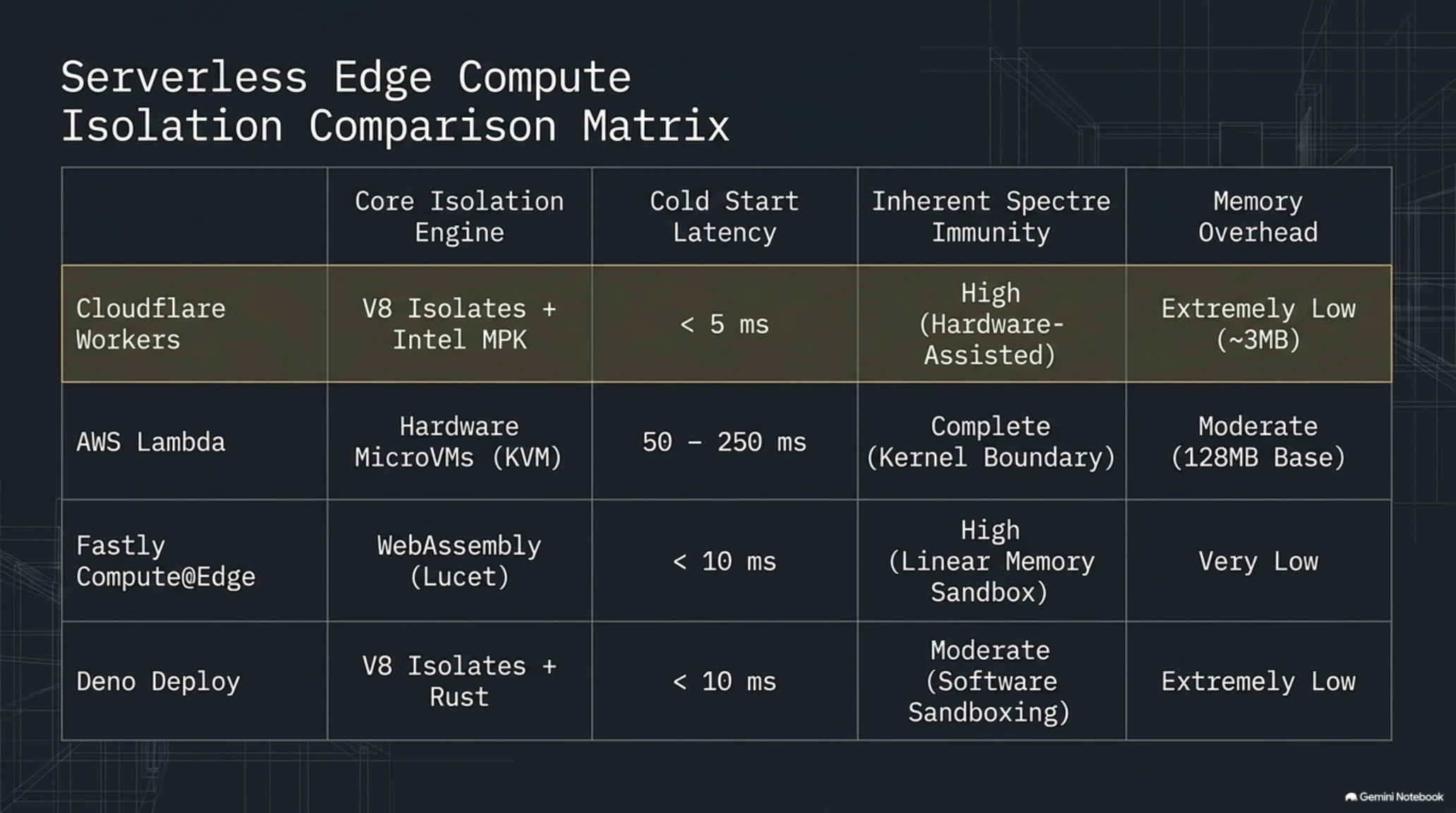
Comparative Matrix: Isolation Models Across Leading Serverless Platforms (2026)
To evaluate how major serverless cloud providers balance execution latency against hardware-enforced tenant isolation, the matrix below details the foundational architectures of the industry's four leading edge compute runtimes.
Serverless Edge Compute Isolation Comparison Matrix
| Platform & Provider | Core Isolation Engine | Cold Start Latency | Inherent Spectre Immunity | Memory Footprint Overhead |
|---|---|---|---|---|
| Cloudflare Workers | V8 Isolates + Intel MPK | < 5 ms (Zero Cold Start) | High (Hardware-Assisted) | Extremely Low (~3MB) |
| AWS Lambda (Firecracker) | Hardware MicroVMs (KVM) | 50 – 250 ms | Complete (Kernel Boundary) | Moderate (128MB Base) |
| Fastly Compute@Edge | WebAssembly (Lucet/Wasmtime) | < 10 ms | High (Linear Memory Sandbox) | Very Low |
| Deno Deploy | V8 Isolates + Rust Runtime | < 10 ms | Moderate (Software Sandboxing) | Extremely Low |

For cloud security architects seeking deeper insights into autonomous system vulnerabilities and adversarial exploitation, consult our detailed teardown of Courtroom AI Prompt Injections & Systematic Reliability Gaps along with the comprehensive threat intelligence tracking in our Tekin Weekly Technology Roundup.
Enterprise Hardening Blueprint: Defensive Best Practices for Edge Developers
While Cloudflare has patched its global edge infrastructure, enterprise platform architects cannot treat underlying cloud platforms as infallible black boxes. The discovery of high-throughput remote side-channels necessitates adopting defensive software patterns that assume memory contents could potentially be probed under adversarial conditions.
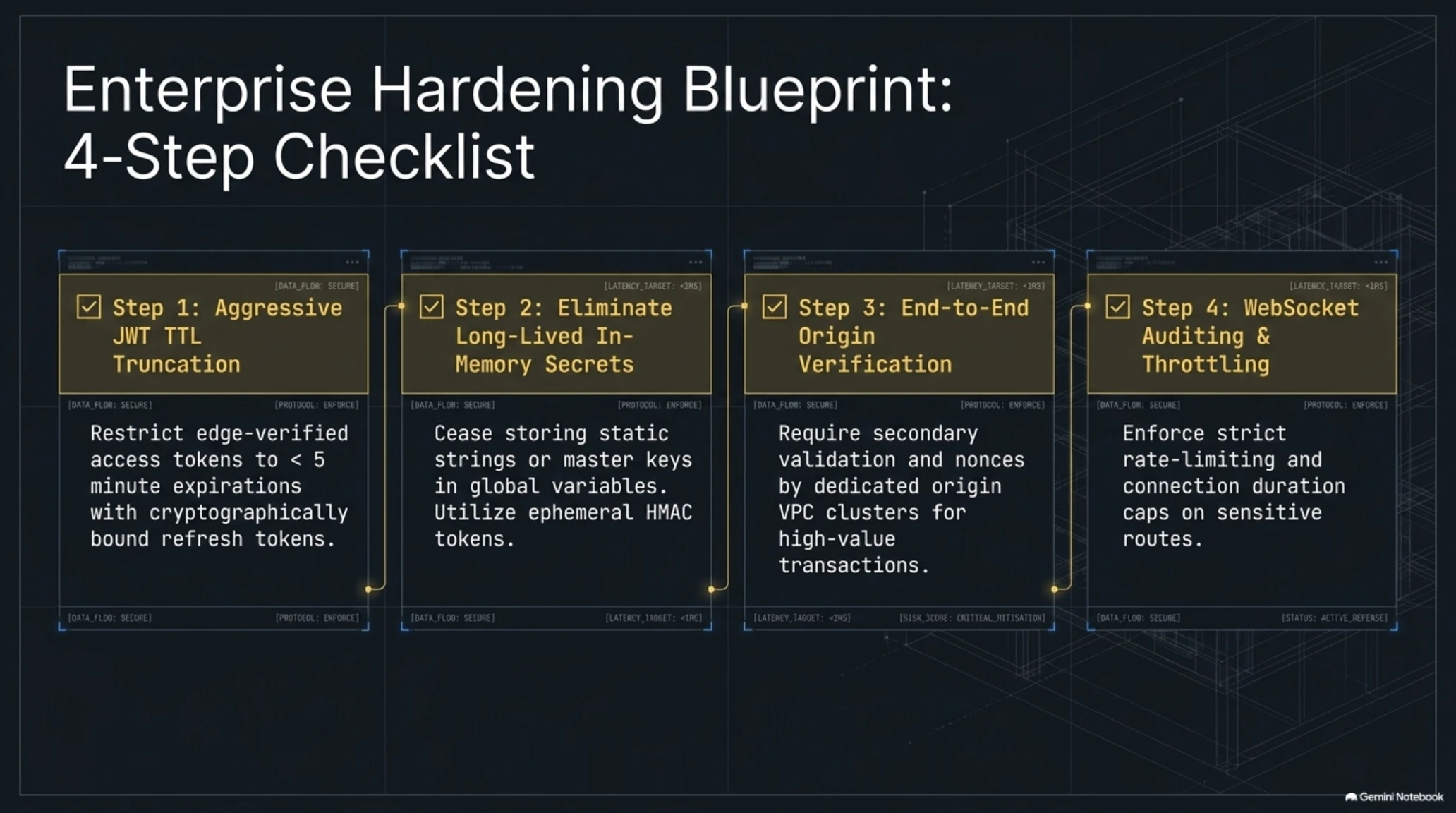
Engineering teams deploying mission-critical authentication, API gateway proxies, and payment verification logic on serverless edge functions must implement four foundational hardening protocols.
4-Step Edge Security Hardening Checklist
- Aggressive JWT Time-to-Live (TTL) Truncation: Restrict edge-verified access tokens to ultra-short expiration windows (under 5 minutes) and implement cryptographically bound one-time refresh tokens to render exfiltrated tokens useless before attackers can weaponize them.
- Elimination of Long-Lived In-Memory Secrets: Cease storing static database connection strings, master cryptographic signing keys, or private API secrets in global worker variables. Instead, utilize short-lived asymmetric key pairs and ephemeral HMAC tokens.
- End-to-End Origin Signature Verification: For high-value transactions, avoid relying solely on edge worker validation; require secondary validation and nonces validated by hardened origin servers located in dedicated VPC clusters.
- WebSocket Session Auditing & Throttling: Enforce strict rate-limiting and connection duration caps on long-lived WebSocket connections operating within edge routes that process sensitive authentication payloads.
- Exemplary transparency demonstrated by Cloudflare in co-authoring and publicly disclosing academic findings
- Rapid global deployment of hardware-assisted Intel MPK mitigations with zero measurable latency degradation
- Zero evidence of customer data compromise or wild exploitation identified across three years of network telemetry
- Establishment of a higher security standard for the entire V8 isolate and edge computing ecosystem
- Empirical proof that shared multi-tenant memory models carry persistent microarchitectural risks
- Imposes an ongoing requirement on enterprise developers to architect resilient, short-lived authentication mechanisms
Market Sentiment & Enterprise Edge Adoption Outlook
Enterprise security surveys reveal that over 82% of Fortune 500 Chief Information Security Officers (CISOs) are mandating hardware-level memory protection (such as Intel MPK or AMD SEV) as a non-negotiable procurement requirement for edge serverless vendors.
Conclusion & The Strategic Future of Edge Compute Isolation
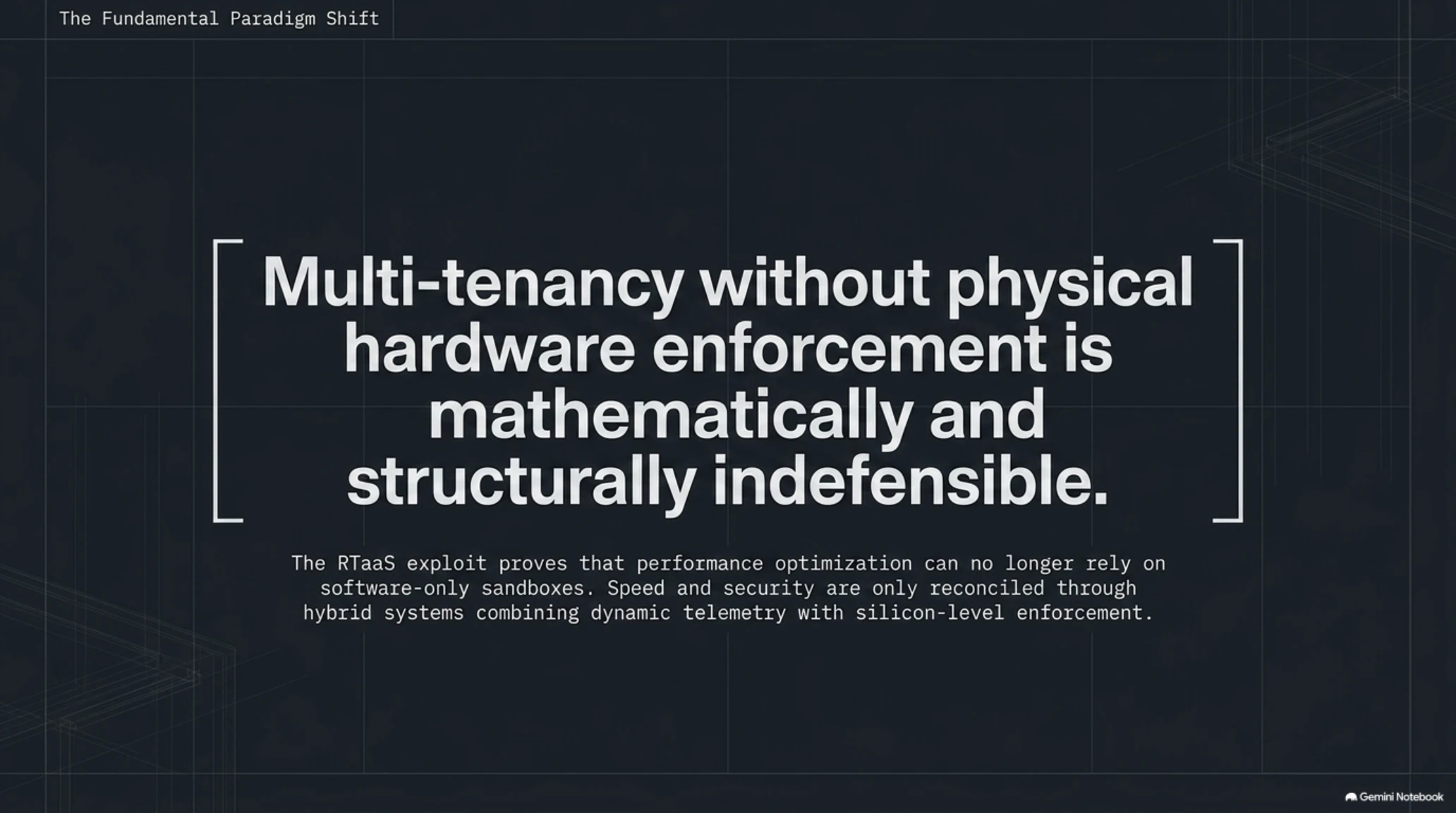
The disclosure and subsequent mitigation of the Remote-Timer-as-a-Service Spectre attack marks a defining turning point in cloud infrastructure engineering. It shatters the naive assumption that software-only sandbox barriers are sufficient to isolate untrusted code on shared silicon. When sub-millisecond execution speeds collide with modern speculative CPU architectures, physical hardware enforcement must stand as the ultimate arbiter of trust.
Cloudflare’s decisive response—unifying dynamic process isolation with Intel Memory Protection Keys—proves that high performance and robust hardware isolation are not mutually exclusive. For enterprise developers and cloud architects, the lesson is unambiguous: build with defense-in-depth, minimize the lifespan of in-memory credentials, and demand hardware-level isolation guarantees from your cloud providers.

Related Industry Features on Tekin Game
• 🤖 Tekin Analysis | Unitree Robotics IPO & AI Prompt Injection Court Battles
• ☀️ Tekin Morning Aug 17, 2026 | Halo Prototype Leaks & The Massive PS5 Account Purge
• 🎭 Tekin Feature | Gamification of Intimacy: How Couples are Using VR & Gaming Tech
Frequently Asked Questions About the Cloudflare Workers Spectre Attack
What was the core mechanism of the Spectre attack on Cloudflare Workers?
The attack exploited speculative execution (Spectre) within shared-process V8 isolates, using a remote WebSocket connection as a high-precision network timing oracle (RTaaS) to read adjacent worker memory byte-by-byte at 12 bits per second.
Was any customer data or private key material compromised in the wild?
No. The research was conducted in a controlled production experiment jointly with Cloudflare, and extensive telemetry confirmed zero evidence of malicious exploitation or customer data exposure.
Why was the 12 bits per second extraction rate significant?
This throughput is approximately 360 times faster than earlier 2021 edge demonstrations, making it fast enough to reliably reconstruct full 256-bit cryptographic keys and JWT session headers within minutes.
How did Cloudflare mitigate the vulnerability across its edge network?
Cloudflare deployed a triple-tier defense combining Dynamic Process Isolation (DyPrIs), V8 Sandbox integration, and hardware-enforced Intel Memory Protection Keys (MPK) across its global clusters.
Official References & Academic Publications
- The Hacker News: Cloudflare Workers Spectre Attack Leaks JWT From Co-Located Worker at 12 Bits/Second (Read Full Report)
- Cloudflare Engineering: Remote-Timer-as-a-Service: Efficient Microarchitectural Leakage in the Cloud with Remote Timers (Cloudflare Research Portal)
- University of Edinburgh: School of Informatics Microarchitectural Security Research Group (Academic Publication Repository)
- US Cybersecurity and Infrastructure Security Agency: CISA Known Exploited Vulnerabilities Catalog (CISA Official Portal)
Additional Gallery: Tekin Analysis | Collapse of Serverless Edge Isolation: Remote Spectre Attack on Cloudflare